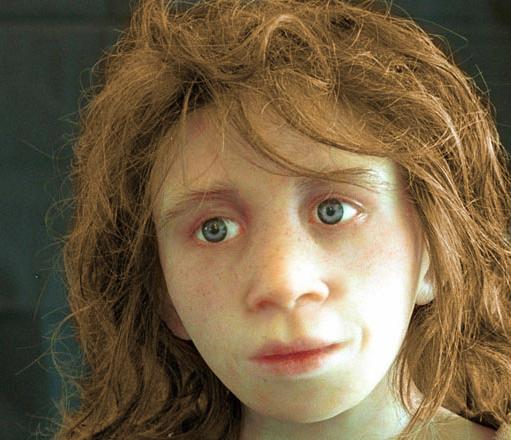
Modified reconstruction of Gibraltar Neanderthal child
Karolina
My primary inspiration for creating the theory, as well as discovering mind-to-mind communication and the relationship traits
Elizabeth Morgan
Helped me with background material about various diseases like hemochromatosis, Factor V Leiden, cystic fibrosis, SLE, other autoimmune diseases, and found various links to supportative evidence
Various autistic and ADHD individuals on discussion forums
Helped me with ideas about behavior and provided comments about the theory
In the past there have been numerous theories for the
cause(s) of neurodiversity conditions like Autism, Asperger's syndrome,
ADD/ADHD, OCD, Social phobia, Dyslexia, Dyscalculia, Bipolar, Schizophrenia,
Tourette and Dyspraxia.
Most of these theories can at best explain small parts of these diverse
syndromes. Many of them extend their findings in spectacular
ways to be able to claim to explain larger parts of neurodiversity
with little success.
This theory approaches the problem from a new radical viewpoint.
Instead of approaching neurodiversity conditions as disorders, brain
defects or the result of poor socialization or parenting, it claims that
neurodiversity is fully functional human variation.
All the areas that are central to neurodiversity are related to
species-typical adaptations that vary widely between species.
These include nonverbal signals, social organization, sensory
acuteness, perception, motor skills, general preferences, sexuality,
courtship, physical traits and biological adaptations. Some of this
diversity is poorly understood and virtually unresearched and therefore
is not published in peer-reviewed journals. Because of this lack of
research, Aspie Quiz, an online questionnary, is heavily referenced
for these traits.
Recent genetic research have demonstrated that Neanderthals
contributed at least 1-4% to the non-African genome.
Aspie Quiz have demonstrated in a large survey in
the US population that Afroamericans have only 1/6 of the
autism incidence of non-African groups.
Principal Component Analysis (PCA) of Aspie Quiz yields
axes that seems to be related to the first Eurasian
Homo, the formation of modern humans in Africa or
South Asia and the hybridization between modern humans
and Neanderthals in Eurasia. In Caucasians, these axises seems
to be 1.8 million years, 150,000 years and 33,000 years.
In Asians, they seem to be 1.8 million years, 130,000 years
and 44,000 years.
Primates originally were very small and evolved during the era of the dinosaurs. Higher primates seems to have evolved 40 million years ago in Asia 1. These then spread to all parts of the world 2. Oreopithecus was a swamp-ape that lived 7 to 9 million years ago on an isolated island in today's Italy. It seems to be more similar to the later Australopithecus than to any other primate. Homo is next in similarity to Oreopithecus while the African and Asian apes show the least morphological similarity to Oreopithecus amongst the hominoids. Oreopithecus was bipedal, just like humans, unlike the knuckle-walking African apes 34. Oreopithecus might be very close to the common ancestor of Pan, Homo and Gorilla. If Oreopithecus was the ancestor of Homo, this would also explain a large number of aquatic adaptations found in today's humans, but not in other primate species. Ardipithecus was a bipedal hominin that has been found in Etiopia 4.4 million years ago 5 6. Ardipithecus has many similarities to Oreopithecus, especially in its foot bones. Australopithecus lived in Africa 3 million years ago. It is typically believed to be the ancestor of Homo, but actually cannot be since humans and orangutans both lack a retroviral insertion that was inserted into the genome of all African apes about 3 millions years ago 7. An early Homo species lived in Eurasia (Dmanisi, Georgia) about 1.77 million years ago. It showed some primitive and some derived features of Homo erectus in Africa and was relatively short 8. Homo floresiensis existed on Flores, Indonesia, already 1 million years ago. It is called "the hobbit" because of its short stature 9. The cladistic analysis indicated it branched from other Homo species already at 1.7-1.9 million years ago 10. Denisovans are known from a cave in Siberia. They diverged some 640,000 years ago from Neanderthals and some 800,000 years ago from modern humans 11. Homo erectus has been found in East Asia from about 800,000 years to 400,000 years ago. After that they evolved towards the modern human form, a transition that was complete about 250,000 years ago. This form then is found in the fossil record up until 100,000 years ago, when the fossil record suddenly ends 12.
The origin of Homo is not clear, but it seems likely that climatic factors played an important role. The start of the ice-ages in Eurasia roughly corresponds to the origin of Homo 13. It seems likely that brain expansion was largely driven by the unstable climate of Eurasia, which required constant adaptations from their inhabitants. These selective pressures never existed in Africa. Africa instead acted a lot like a refugee area where larger populations could survive for extended periods of time. Frequent hybridization between advanced, but sparse, Eurasian Homo and refugee African Homo ensured that Homo evolved larger brains.
Rather than describing all the species or sub-species paleoanthropology likes us to believe existed in Eurasia, it's more convenient to describe them as one single species evolving from Homo erectus to Neanderthals. The earliest finds of Homo come from Sima del Elefante, Atapuerca, Spain and are 1.1 to 1.2 million years old 14. It is believed to be related to Dmanisi. Another find is from Ceprano, Italy that is dated to between 800,000 and 900,000 years 15.
This species evolved from Homo erectus to anatomical modern humans (Hss). In the process of increasing their brain size, or maybe as a means of reducing parasite loads, they became naked. They lived a nomadic life-style in larger tribes. Their way of living provided advanced social adaptations. Men were hunters, and women gathered and cared for babies. With those roles, came male alliances and warfare. It was more of a rule to find one's partner within the tribe than in another tribe. This lead to evolution of the modern status concept and hierarchies. It also lead to aggression between males, and provided the basis for ethnocentric ideas and racism. The offspring developed fast, and they could reproduce fast. Hss is a patriarchal species and behaves like chimps in many respects.
At 130,000 years ago, a global warming started. This resulted in the melting of the ice-cores over Eurasia. At 125,000 years ago, we find Neanderthals in Finland 16. In Africa there are a couple of skulls in Herto that are dated to 160,000 years ago, that almost looks like modern humans 17. It is likely that the warm interglacial resulted in migrations of Herto-looking Homo out of Africa and into South Asia and Near East 130,000 years ago, similar to the Neanderthal migrations north.
Based on archaeological evidences, it seems most reasonable to assume that modern humans originated somewhere in Asia. We have evidences of the first truly modern-looking human skull in China around the interglacial (Liujiang) 18. Modern humans formed when they hybridized with the archaic Asian Homo erectus population. As the interglacial ended, the new population was pushed back into refugee areas in Southern Asia and Middle East. We find modern humans at Skhul and Qafzeh in Israel at the end of the interglacial 19. These modern humans also hybridized with Neanderthals in Near East, before being pushed back into Africa.
Today the closest descendants of these people seems to be San/Bushmen of South Africa, and South Asian populations. The Bantu population of Africa quite likely represents hybrids between modern humans and archaic African Homo. It is unknown when San came to Africa, but their similarity to East Asians seems to imply a relatively recent migration into Africa, perhaps 20,000 - 30,000 years ago. At 74,000 years ago most of the genetic diversity in Asia was lost, and Asian modern humans got partitioned into two groups by the Toba eruption. Not until 50,000 years ago had this population picked up enough inventions from neighbouring Neanderthal and Homo erectus groups to be able to survive further north. With the invention of tailor-made cloth and efficient central-heating, it became possible for them to compete with Neanderthals in Europe and Northern Asia. 35,000 years ago, modern humans are found in Europe
The cold-adaptations of the northern population probably evolved gradually. It was already present to some extent one million years ago in Iberia. The 500,000 years divergence of mtDNA lineages between Africa & Neanderthals support the idea of a northern cold-adaptation starting before 0.5 million years ago. There are several evidences against the idea that Neanderthal adapted to cool climate with fire and cloth in Eastern Europe 24.
The evidence from fires indicates they were not primarily aimed at keeping warm. In modern human settings in Europe, there is a central fire & evidence of isolated shelters. None of this is seen in Neanderthal's Mousterian technology. Their fires are usually found at arbitrary locations, and there is no evidence of activity constrained to shelters. The evidence seems to indicate Mousterian sites were indeed "open-air", and not built with tents & central heating.
There is no evidence for new technology as Neanderthals migrated to colder climates. This seems to indicate their adaptations were not cultural, because this would leave traces of innovations in technology, but rather physiological.
Many sites were abondonded by Neanderthals when climate got worse. It's possible this reflects that Neanderthal cold adaptations weren't enough to cope with the changes.
Side-scrapers might have been used for hide preparation, although there is more evidence they were used for wood-working in Western Europe. Furs without advanced sewing techniques would be insufficient for cold adaptation, and there is no compelling evidence for Neanderthals sewing.
Polar bear cold adaptation
The polar bear is believed to have parted from brown bears 100,000 to 250,000 years ago 25. This is far less generations than H erectus had adapted, and thus we would except to see more changes in Neanderthals than this. The following happened to polar bears:Switch of diet from predominately vegetarian diet to carnevorious diet
Widely different teeth, more adapted for a predator.
Year-around activity instead of hibernation
Longer neck
Different color
Thick fur
Huge paws
Wolly mammoth cold adaptation
The mammoth parted from Elephants in Africa 5-6 million years ago 26. Already 2 million years ago, they were fully adapted to Arctic conditions 27. The Wolly mammoth went all the way from warm-adapted & virtually fur-less to superbly adapted to Arctic conditions in the same time frame H erectus to Neanderthals had.Artic fox cold adaptation
The artic fox split off 3 million years ago 28. They have much the same adaptations we would expect in Neanderthals.
The fur of the arctic fox has the best insulative properties among all mammals
Not under any naturally occurring temperatures does it need to increase metabolic rate to maintain homeothermy
Arctic foxes change between summer and winter pelage and thereby adjust insulating properties and enhance camouflage
Well developed ability to reduce blood flow to peripheral regions of the body
In autumn, they can put on more than 50% of their body weight as fat for insulation and as energy reserves
Muscari
Grape hyacinth is a stimulant and diuretic. It's also been used historically to hide the snell of humans to prey.
Althea
Possibly Althea officiinalis or Marsh mallow. Used to treat inflammation, irritations of the mucous membranes, excess stomach acid, peptic ulceration and gastritis. Can also be applied externally to bruises, sprains, aching muscles, insect bites, skin inflammations and splinters.
Senecio
Ragwort or groundsel is used to relieve menstrual cramps and retards bleeding.
Achillea
Yarrow or milfoil is used as a stomach tonic and anti-diarrheal.
Centauarea
Possibly Centaurea cyanus or cornflower. Infusion is a stimulant, improving digestion and possibly supporting liver as well as resistance to infections. Anti-rheumatic.
Ephedra
A stimulant used for phychoactive purposes. Possibly used by Neanderthals to increase activity-level artificially, and could therefore have reduced their overall activity level over time.Genetic research shows that dog and wolf parted 135,000 years ago 32. They also reveal that the dog's ancestor was the European gray wolf. There are wolf remains close to Neanderthals, but not with the prey. This probably means the wolf had a special relation with Neanderthal. There are also big similarities between Neanderthal prey and wolves prey 33. Some people incorrectly believe that dogs must change morph to be dogs and domesticated, but this is related to a power relationship between humans and animals and not a symbiotic relationship. Raymond and Lorna Coppinger believe dogs first appeared at humans campsites as scavengers. This view is compatible with early symbiotic relations between dogs and Neanderthals. What's more, the selection would not be anything like traditional breeding. The tamest animals would be most successful in this new environment, but selection on body-shape would not occur. Those first dogs would not look anything different from their wild wolves cousins in the archeological record. The book "dogs" also describes how difficult it is to make wolves friendly toward humans. They must be taken very early from the den, and trained for months 34.
A study comparing Bos indicus and Bos taurus finds a common ancestor 117,000 - 275,000 years ago 35. The now extinct British Bos primigenius is more closely related to Bos taurus than is Bos indicus.
Genetic evidence shows that three goat lineages go back 201,000 - 282,000 years in time 36.
Mitochondrial DNA lineages go back at least 300,000 years. A lot of the lineages are considerably older than 10,000 years when the horse was supposedly domesticated 37.
Let's start with children & young adults. That's where his evidence is impressive. On page 185 there is a table estimating the years Between Pech (a very young child) and Le Moustier
|
Linear or Angular Meassurement |
Average Rate/Yr |
Years |
|
1. Michigan Angular Variable 50 |
0.85 |
27 |
|
2. Bolton Angular No. 13 |
0.57 |
26 |
|
3. Michigan Linear Variable 88 |
1.2mm |
26 |
|
4. Bolton Linear No. 5D |
1.2mm |
26 |
|
5. Bolton Angular No. 3 |
0.66 |
27 |
|
6. Michigan Linear Variable 182 |
1.3mm |
29 |
|
7. Michigan Linear Variable 185 |
1.8mm |
26 |
|
Average: |
|
26.7 +/-1 |
This 7 meassures are different rates of growth, using large modern studies. It's quite remarkable that all of them gives very similar results for the age differences between Le Moustier and Pech. Using dental dating methods, Pech is believed to be between 2 and 2.5 years old. I'll use the mean 2.25 years. Le Moustier is assumed to be between 16 and 18 years old. I'll use 17 for his age. The difference in age based on dental datings therefore is 14.75 years. This would mean there is a discrepancy between general skull growth and teeth growth of 1.81 (26.7 / 14.75). This can be explained by assuming seasonal wear of their teeth. If teeth eruption & wear is proportional to the effective usage-time of teeth, this would be a legal assumption. This means Neanderthals would use their teeth for 1 / 1.81 or 55% of the time, and would not use them for 45%. That translates to 6.5 active months and 5.5 months of hibernation or general inactivity. Using those assumptions, let's calculate the age of various Neanderthals. The general rule for children & young adults would be to multiply the traditional ages by 1.81. This would mean Pech would be 4 years, Gibraltar II 7 years and Le Moustier would be 31 years.
Next, comes the fallacy of Jack's reasoning. Age of adults. The real problem here is that we don't know the exact age of maturity. Le Moustier cannot be assumed to be mature. The exact time of maturity matters a lot, since skull growth in the measures used in the book beyond maturity falls 20 - 30 times. He assumes maturity and Le Moustier is the same thing, but it's most likely not. The most reliable way to calculate age of maturity, is to estimate average life-span. Since Neanderthals matured 81% slower, they should also have lived correspondingly longer. This means realistic life-spans should range between 100 and 150 years. Using that span, it's possible to use 3 of the measures in the book, and estimate an age of maturity that is realistic. Several iterations proved this age is 36, but I won't go into the calculations, just show that it gives reasonable results.
Gonial angle
On page 306, there is a specification of gonial angles, and the rates. LM (Le Moustier): 110, LC (La Chapelle): 105, LF (La Ferrassie I): 104. Rate in adulthood is 0.026/year. Rate before maturity is 0.86/year (p185). This gives the following table:|
|
Gonial angle |
Estimated age |
|
Le Moustier |
110 |
31 years |
|
Mature Neanderthal |
105.75 |
36 years |
|
La Chapelle |
105 |
65 years |
|
La Ferrassie |
104 |
103 years |
Lower jaw length
On page 306, variable 194, specifies LM: 116.3, LF: 131.3 and LC;132.3. Rate is 0.071mm/year. On page 180, it's stated that the lower jaw grows 1.8mm/year before maturity. This gives the following table:
|
|
Lower jaw length |
Estimated age |
|
Le Moustier |
116.3 |
31 years |
|
Mature Neanderthal |
125.3 |
36 years |
|
La Chapelle |
131.3 |
120 years |
|
La Ferrassie |
132.3 |
135 years |
The book claims ages of 211, 225, 231 and 192 for the above. This is because of the assumption of LM being mature. It's very clear you can come up with almost any age with this method, since maturation time is not known. I think 36 +/- 2 of maturation is supported by the data. Outside of this range, age of death of LC and LF is becoming unrealistic.
Lower face height
This is the third measure that can evaluated both in children and adults, as is required when maturity is 5 years after LM. This is the most interesting of them. Neither the traditional dating method, nor the presumed in this book, would explain this. On page 212, there are estimates for this parameter. Modern adults grow 0.063mm/year. Between 16 and 18, there is an increase of 1.98mm, which roughly corresponds to 1mm/year, which I will use as an estimate before maturity. He also discusses the fact that modern humans with heavy tooth-attrition, DECREASE lower facial height. This is because passive tooth eruption is smaller than teeth wear. On page 215, he gives the figures for our Neanderthals. LM: 58.3, LF: 75.8 and LC: 78.7. The problem here is that we have to assume a very high increase in lower facial height of 0.15mm/year to obtain realistic results. Here is a table based on 0.15mm/year:
|
|
Lower face height |
Estimated age |
|
Le Moustier |
58.3 |
31 years |
|
Mature Neanderthal |
63.3 |
36 years |
|
La Chapelle |
78.7 |
139 years |
|
La Ferrassie |
75.8 |
120 years |
If Neanderthal had such a large growth as
0.15mm/year, which is over twice the modern rate with SOFT diet, how
is this possible? I think the answer once more is hibernation. If
we assume they had the modern rate during active periods (55%), and
only passive eruption during the rest of the year (45%), we could end
up at 0.15mm/year. If their passive eruption was 0.25mm/year, this
would contribute to 0.112mm/year of growth (0.25 * 0.45), and the
active 0.038mm/year (0.07 * 0.55). On page 211, there is an study
that gives rates as high as 0.18mm/year for this parameter, with "no
wear".
On page 76, there is an excellent summary of
Gibraltar II by Dorothy Garrod:
|
A. Remarkable jaw muscle development |
old |
|
B. Well-worn teeth |
old |
|
C. Infantile forehead |
slow |
|
D. Big head |
old |
|
E. Infantile ear bones |
slow |
|
F. Bulbous upper jaw |
slow |
|
G. Small young-looking lower jaw |
slow |
F and G is explained by slow-developing teeth, and is the reason for the wrong age-estimates by paleoanthropology. Slower ear development might be related to Neanderthals obvious preference for visual information processing instead of verbal (as evidenced by occipital bun). The forehead is most likely explained by a less advanced social system.
Additional evidence comes from a study that found Fibrous Dysplasia, that typically develop with age and is uncommon in human populations before the average lifespan of humans increased recently 39.
Matriarchal societies are mainly found in Europe, Near East and the Arctic, and usually disappear with agriculture 41.
These people's are often believed to be some of the original Africans, but many of their traits speaks against this idea. They resemble, to European eyes at least, east Asians. They have yellowish rather than black skin, epicanthic folds, shovel-shaped incisors, and many newborns have "Mongoloid spots" at the base of the spine. The Asian appearance is not just a perception of Europeans. In the !Kung language there are three kinds of mammals: !a is an edible animal like a warthog or a giraffe, !oma is an inedible animal like a jackal, hyena, black African, or European, and zhu is a person. Vietnamese in Botswana were immediately identifed as zhu by Bushmen. In other words, their perception of their similarity to Asians is the same as ours (i.e. Europeans'). Genetics group Bushmen with Asians 42 and Bushmen lack the signal of expansion present in other African populations 43. Bushmen are thought to have introduced live stock into South Africa 44.
Many of the Basque-unique alleles are 10,000 to 34,000 years old. The center of this interval matches the bottleneck in Iberia during the ice-age maximum. Basque alleles are also found in Celt, Scandinavians and in North African Berbers 45. In Isturitz in Basque country there is an very old flute. This flute is similar to both the older Neanderthal flute, and the later Basque txistu flute. The Basque language is distinct from all other languages. Their language is also special since it originally didn't contain any abstract words. Basque has also for a long time been leading in musical and other creative activities in Europe. The Basque words for dog, sheep, cow, bull, horse and hen seems unrelated to other Indo-European languages, while cat, pig and duck looks like loan-words. This indicates the first group of animals already were domesticated before the end of the last ice-age.
Berbers most likely originate from Iberia during the ice-age maximum. Mitochondria-DNA evidence shows that Berbers have U5, U6, pre-V and V haplotypes 46. U5, pre-V and V is believed to be of European origin, and U6 is found in Iberia 47 48.
Guanchos came to the Canaries a long time ago. When first encountered, they used stone-age tools, lived in cave-shelters, and lacked many Neolithic inventions. However, they had dogs, sheep, pig, goat, wheat, barley, pea and bean. They also display many features of Northern Europeans / Celts. It also looks like their language is closely related to the Berber language. Women had high status.
Etruscans according to most sources have lived long in Italy. Probably several thousand years, since their language is not related to other indo-European languages. Women had higher status and were better treated 49 50. This is in conformance with matriarchy. Their sexual activities are quite similar to bonoboo's 51. Many gods were female, and many of the goddesses were not continued by the Romans, while many male gods were The moon is part of their deities The number 13 of the original moon culture had been replaced by 12. Music and dancing is a fundamental part of their life, just as theatre.
The Minoan culture flourished on Crete until 1450 BCE when the volcano Santorini erupted. It seems to have been a relatively peaceful culture, and nowhere do we find evidence of warefare 52. It also seems quite likely women occupied important positions in the society. The Minoan culture also seems to have developed a highly accurate calendar, and advanced mathematics 53. They had a non-indoeuropean language, that nobody yet has been able to decipher.
Palaeo Eskimo (the Dorset people)
The Palaeo-Eskimo was the population living in the Canadian arctic between 2000 BC and 1000 AD. They seemed to be a genuinely cold-adapted population 54. They were probably related to other Eskimo population like Tlingits and Saami. Their area of origin might very well be somewhere in Caucasus or Central Asia. The most interesting issue is how these Palaeo-Eskimos survived the winter. This is very relevant to Neanderthals as well. Since these people lived in an area with no trees, and hadn't invented sea mammal fuels, it's unconceivable they could keep themselves warm without some genetic adaptations. In fact, torpor, hibernation or at least months of inactivity must have been their way of surviving. Considering outside temperatures could easily drop to -30 degrees Celsius, with frequent blizzards, and months of total darkness, they would simply die of cold and starvation very fast if they didn't have special adaptations. Indeed, it seems likely they got those special adaptations from Neanderthals. Their region of origin is quite right. As soon as they started to live under extreme conditions in the arctic, individuals lacking those special adaptations would quickly be selected against. The Dorset people's demise is also quite telling, and might in fact be a parallel to what happened to Neanderthals. The large, war-oriented Inuit groups obviously drove out the peaceful Dorset people to less favorable hunting-grounds, and they become extinct after a couple of centuries. There are several indications that the Palaeo Eskimos were matriarchal.
There is no evidence for a special dog phenotype older than 14,000 years, and analysis of American historical dogs claim they have an Eurasian origin. They must then have been brought with the settlers that crossed the Bering strait at least 15,000 years ago. It's also unlikely that the common dog psychological traits can have evolved in just a few thousands years. It's quite interesting that dogs are sensitive to human cues 55.
The lineages diverged during the Neanderthal era. Mitochondria DNA analysis shows that Bos taurus (domestic cow), has a common ancestor between 10,100 and 37,600 years ago. This matches the bottleneck cattle went through when the European population had to leave at the end of the ice-age. African and European cattle had a common ancestor 22,000 - 26,000 years ago. That matches well with the last glacial maximum 56. It seems conceivable this is the result of cattle and people migrating together from Iberia to North Africa 57. This means there are three primary breeds of domestic cattle:
The lineages diverged during the Neanderthal era, and similar to the cattle scenario, diverged in a North African, Sumerian and European breed.
The lineages diverged during the Neanderthal era. European horses were taken to North Africa where they formed Barbs. They couldn't have been introduced from Middle East with agriculture, since this mitochondiral DNA variant is rare in Arabs.
Aspie Quiz was created in 2004 with an objective to show that Asperger's syndrome was natural variation rather than a disorder. In 2013, the construction process was published 59.
In 2006, the dual nature of human variation was discovered with factor analysis. Factor analysis (PCA) of Aspie Quiz always resulted in two major factors that accounted for 2/3 of the variation in the items used. Aspie Quiz defined neurodiverse function as the first factor and neurotypical function as the second factor. In the context of the current theory, the neurodiverse factor relates to Eurasian ancestry (Hn factor), the neurotypical factor relates to African ancestry (Hs factor) and the third factor relates to hybrid vigor (g factor). If age of these factors is proportional to explained variance, and the Hs factor is set to 150,000 years old, then the Hn factor becomes 1.8 million years old and the hybrid vigor factor becomes 37,000 years old. The results in Asia differ slighty, and if the Hn factor still is assumed to be 1.8 million years old, then the Hs factor becomes 130,000 years old and the hybrid vigor factor becomes 44,000 years old. These results can be explained based on the evolution of Homo. The Hn factor relates to the divergence between Eurasia and Africa which started with Homo erectus. The Hs factor relates to the last interglacial 130,000 years ago, which originated the modern human phenotype which later spread to Africa. The hybrid vigor factor shows that hybrization occured first in Asia and later spread to Europe.
Factor loadings were used as weight factors for scoring the test, which resulted in an objective scoring method. The neurodiverse score was based on the neurodiverse factor and the neurotypical score was based on the neurotypical factor. The score difference was the difference between the neurodiverse and neurotypical scores, and was used to give classifications. Aspie Quiz selected items based on uniqueness and relevance only, and didn't look at psychiatric diagnosis definitions, which resulted in an objective item selection process. Tests for Autism, ADD/ADHD, Social phobia, Tourette and Schizotypal correlated substantially to the score difference. The score distributions didn't support the idea that neurodiversity was at the extreme end of normal function, rather neurodiverse and neurotypical function had their own overlapping distributions. The neurodiverse and neurotypical scores typically correlated -.96, which indicates that neurodiverse and neurotypical traits are mutually exclusive. Another peculiarity was that traits with higher correlations to the score difference had higher correlations to other random neurodiverse traits. This also means that random neurodiverse traits tend to be correlated even if they have no casual relationship, which is why so many invalid conclusions about casual relationships have been made. In Aspie Quiz, the relationship between traits is estimated by comparing the correlation between the traits and their correlations to the score difference. Only if the correlation between the traits is 90% or higher than the correlation to the score difference are the traits suspected to be related in some way.
Unlike in the diagnostic procedure as well as in screening instruments for ASD, Aspie Quiz doesn't have a gender bias in scores and males and females have a similar neurodiversity prevalence. People of African descent in the US had only 1/6 of the interest rate, but among those that participated, scores were similar to those of other groups. Since interest in neurodiversity is the primary reason for doing Aspie Quiz, this means that people of African descent are much less likely to be interested in neurodiversity, probably because they don't feel different from the majority population. Participants from South Africa also were much more likely to be of Caucasian origin compated to their proportion in the general population.
Problems with reading typical facial expressions and other nonverbal communication is a defining trait of autism spectrum diagnosis, but also a rather common trait in neurodiversity. The typical communication traits are covered by the neurotypical communication group 60. Inability to understand nonverbal communication is highly maladaptive for an individual in a species and so is strongly selected against. On the other hand, nonverbal communication is widely different between species, and so if neurodiverse people are from another species we would expect trouble with understanding nonverbal communication of the majority population.
Facial expressions are the most important means neurotypical people have to figure out the emotional state of others. As children, some neurodiverse people are not even aware of the importance of facial expressions. The Reading the mind in the eyes (RMET) is a test that tries to match an image of the eyes of a person with a list of predefined emotions 61. There have been conflicting results from studies using the RMET, but neurodiverse people seem to respond slower 62. When the RMET was validated in Aspie Quiz, the z scores correlated .29 to score difference in the child version version and .35 in the adult version. Trying to optimize the RMET in an iterative process by using the same images but optimal emotions that discriminated best between the groups gave a correlation of .45 to the score difference 63. In addition to better discriminative properties, the number of non-answered eyes also decreased considerably. Many of the images gave high relevance when staring was used as one of the emotions, something that many neurodiverse people selected but almost no neurotypical. While there were a few novel differences in the interpretations, there were no general trend that neurodiverse people might have slightly different natural interpretations of facial expressions. None of the faces had a different majority interpretation between neurodiverse and neurotypical people. The differences in interpreting facial expressions could be explained in two different ways. Either facial expressions as a means of communication was shared between Neanderthals and modern humans, but this appears to require that we see some divergence in the meaning of the expressions, or Neanderthals didn't use facial expressions for communication at all. The evidences seems to suggest that Neanderthals didn't use facial expressions to communicate, and that many neurodiverse people have learnt how to interpret neurotypical facial expressions rather than having this as an innate ability. This can explain the slightly lower accuracy as well as the longer response times. Avoiding to look at faces or regarding them as staring, seems to act as a distractor that makes neurodiverse people miss the importance of facial expressions when interacting with neurotypical people.
Stims provides another possible way to communicate and build up a part of the neurodiverse communication group 64. Stims are called 'repetitive behaviors' in the autism literature and in the diagnostic manuals. Stims are often targeted for removal by treatment programs, probably because they are easy to spot. Many autistics object to the idea that stims would be a pathology, and some do them in private but not in public to avoid the stigma. A related concept is tics, which has been specifically pathologized in the Tourette syndrome diagnosis. Aspie Quiz links stims with tics, and doesn't support the idea that tics are a specific pathology, but instead suggest they are similar and should be treated as a single concept. Stims relate to the hunting traits, and some other emotional differences, and form the neurodiverse communication group in version 3 and 4. The connection between stims and emotions / states was evaluated in an iterative process similar to the RMET optimization of facial expressions 65. A few stims did have a specific emotional connection that was much more common in the neurodiverse population than in the neurotypical, but many stims also related to more generic states like 'for fun'. Thus, it doesn't seem like stims could act like a complete replacement for facial expressions.
Schizophrenia, psychosis and schizotypal personality all are related to neurodiversity, and it seems like the screening instruments primarily focus on supernatural traits and hearing voices. Since these traits are linked to neurodiversity, and most other traits linked to neurodiversity appears to be evolutionary adaptations, a similar position must be taken towards supernatural traits. Belief in ghosts and the supernatural is slighty more common in neurodiversity 66, while actual experiences with the paranormal 67 and having psychic abilities. 68 shows a strong correlation with neurodiversity. A research study of religious experience in autism concluded that autistics were more likely to be atheists, but also more likely to have spiritual experiences which included paranormal and psychic experiences 69. Another oddity was that being sensitive to electromagnetic fields 70was much more common in neurodiversity, and this trait correlated to psychic abilities.
Based on these evidences, a study in Aspie Quiz asked participants if they could detect somebody's presence without seeing them, which many more neurodiverse people answered 'yes' to. If neurodiverse people can detect presence without using the normal sensory channels, this means they must have some other physical sensory channel. Given the evidences of sensing electromagnetic fields and having psychic abilities, it's assumed that neurodiverse people can use the electromagnetic medium to communicate, and that this might work over large distances.
Many neurodiverse people have trouble with relationships and dating.
Different possible courtship behaviors were researched with Aspie Quiz and then published online
82.
In the neurotypical population, it was found that some men would court (or harass, depending on interpretation model used) attractive women with sexual comments (cat calling).
This often was done in a group, probably because of the anonymity offered, and the targets were often single women.
Some neurotypical women found cat calling interesting, while a large majority of neurodiverse women found it highly disgusting.
In the neurodiverse population, it was found that experimenting with public nudity was a lot more common (for both genders, but more so for men).
Public nudity is a common problem among lower-functioning autistics in group homes.
Exhibitionism is never done as a group activity, and the targets are often a group of women rather than single women.
Neurodiverse women were slightly less likely to find exhibitionism disgusting.
Other differences included more contact attempts and talking in regards to cat calling compared to exhibitionism.
While cat calling is considered wrong in many Western countries, it is still legal, while exhibitionism has been criminalized.
Russia is a bit special since it has not criminalized public nudity, and results showed considerably less disgust reactions towards exhibitionism, which indicates that much of the disgust reactions in the West are cultural.
In Aspie Quiz, neurodiverse courtship behaviors are primarily covered by having unusual sexual preferences, which links with public nudity
83and being more sexually attracted to strangers than to people you know well
84.
Sex appears to be a central part of bonding between neurotypical people, but many neurodiverse people, and especially women, identify as asexual 85. Asexuality is a neurotypical relationship trait in the sense that sexuality is a central part of neurotypical relationships, and so being asexual is a 'problem' trait. Asexuality was researched in Aspie Quiz and then published 86. Typically, asexuality is assumed to be a lack of sexual attraction, but this fails to explain the much higher prevalence in neurodiversity. Even with research on typical populations, it seems like masturbation is very common among asexual people, which appears to be inconsistent. In the research study, it was concluded that the alternative description "Do you find sexual intercourse disgusting?" correlated strongly to identifying as asexual, and had the same profile. The study found that asexuality linked with other neurotypical relationship traits, but not with neurodiverse relationship traits, and in particular not with having unusual sexual preferences. Asexual identification as a teenager mediated problems with sexual intimacy later in life. Identifying as asexual only acted as a mediator and not as a outcome, and can be viewed as a disgust reaction towards bonding with sex. Asexuality had much stronger links with dislike for tongue kissing and oral sex (both which are neurotypical relationship traits) in the neurodiverse population.
Attachment (bonding) is very important for creating long-term stable relationships. Infatuation and attachment was researched in Aspie Quiz and then published
87.
Neurodiverse people had much higher infatuation scores, which showed that crushes were far more important for neurodiverse people than neurotypical.
Crushes also frequently create a lot of problems for neurodiverse people when they continue even after the other part has already moved on.
In the neurodiverse population, people obsessions mediated higher attachment scores, and the primary increase in attachment occured at a distance.
In the neurotypical population, the primary increase in attachment occured during dating, quite likely because neurotypical people
typically start to have sex after a few dates, and so it might mostly be sexual intercourse that mediates attachment in the neurotypical population.
In the neurodiverse population, dating had the effect of drastically reducing infatuation, which led to a stagnating attachment.
In Aspie Quiz, the neurodiverse differences in infatuation and attachment are primarily covered by having stronger than normal attachments
88 and being taken advantage of because of a too strong attachment (infatuation)
89.
Gender identity issues were researched in Aspie Quiz and then published 90. The primary objective was to check if neurodiverse people that identified as non-cis gender or transgender would show a bias that related to biological sex or their gender identity on items that showed a gender bias. Results showed that although some stereotypical gender traits to some extent had a gender identity bias rather than a biological sex bias, traits that are not widely known to be gender biased had a bias based on biological sex and not gender identity. This was particularly obvious for neurodiverse traits with a gender bias. Neurodiverse people that identified as non-cis gender tended to have neurodiverse relationship preferences. Being part of the LGBT community biased answers to questions about gender identity and asexual identity had a small correlation to non-cis gender in the neurodiverse population. Because of these results, it's more plausible that neurodiverse gender identities are based on different traits than neurotypical gender identities. When many stereotypical neurotypical gender identity traits are irrelevant for neurodiverse people, this might lead some people that dislike the stereotypes to pursue unusual gender identities.
In the infatuation and attachment study it was found that neurodiverse people's attachment was primarily built at a distance (before people started to talk to each other). Some of these distance love stories had been going on for a long time, sometimes years. Neurodiverse males have a lot of problems to start a conversation with a love interest, and often simply cannot do it even if they train themselves. This is probably an innate blocking aimed at keeping things at a distance. Several neurodiverse relationship traits seems to support the love at a distance scenario: Having an urge to know the routines of people 91, having an habit to observe the habits of humans and animals 92, and liking to follow or walk behind people they are attached to 93, but disliking when other people walk behind them 94. Neurodiverse people are more likely to have completely imaginary relationships 95which seems to be at the extreme end of love at a distance. Spiritual beliefs and the psychic traits suspected to be part of neurodiverse communication are actually linked to neurodiverse relationship traits 96. So, perhaps love at a distance works because neurodiverse people can communicate with each other through the electromagnetic medium and so it is not so much at a distance as it appears to be?
It seems to be more common for neurodiverse than neurotypical people to prefer cold weather 97.
It's common with more body-hair in Europeans, and especially in neurodiverse people 98. Peeling skin flakes from self or others is also more common among neurodiverse people 99. This seems to be a grooming behavior commonly seen in other primates which indicates an evolutionary past with a fur-coat.
Seasonal affective disorder and hibernation
Seasonal affective disorder is similar to hibernation 100. People with seasonal affective disorder have a seasonal clock 101. It's origin might be as a winter adaptation similar to how a bear would reduce activity and metabolism to survive during the winter. It's very probable that considerably less than 1.7 millions of years is enough to evolve hibernation, given it has a selective advantage. All three of the deepest branches of Mammalians have species that can hibernate 102. This means the genes required for hibernation is part of all mammalian species, and can be turned on rather quickly. There is also an example of a primate species that can enter torpor. Seasonal affective disorder is a neurodiverse trait 103 104.
Neanderthals probably collected for the winter season. Excessive collection of similar things is a neurodiverse trait 105.
Large short term variation in activity level is associated with ADHD. Longer term (seasonal) variation in activity level is related to Bipolar, but also to neurodiversity 106. Large variation in activity level can be seen as a winter adaptation. It provides a means to lower brain energy consumption.
Overweight and eating disorders
Eating disorders are common in the western society. Unusual eating-patterns are common in neurodiversity 107. Eating disorders have a logical explanation. Seasonal populations depending on a high-meat diet have a more uneven access to food than tropical hunter-gatherers. The ability to eat food fast is important, just as the ability to be without food for a period of time. Is seems like seasonal affective disorder is related to bulimia 108. Overweight is a new problem, whose cause is that we don't have to starve through the winter. For Neanderthals, it was essential to be able to increase weight in summer, and loose it during winter. This is probably why they had a broader pelvis 109. David Comings has associated ADHD and Tourette with weight problems 110.
A population living near glacial ice might be expected to evolve instincts for detecting extreme floods from glacials. These events would be fatal but yet possibly partly predictable. Autistics have a fascination for slowly flowing water 111, but are afraid of floods and fast running streams 112.
Most of the finds of Neanderthals are from caves. It's possible that Neanderthals spent a lot of time in caves, or maybe they hibernated there during winter. Autistics have a fascination for caves 113. Many autistics are afraid of the sound of a motor-bike 114. A motor-bike sounds similar to a bear. It is possible that the instintive reaction of autistics when they hear the sound of a motor-bike triggers an ancient fear for cave-bears.
There are many other differences in autistics as well. Below is a summary of other differences and their possible original function.
Squinting is highly correlated with autism 115 and so is using peripheral vision. 116. Autistics tend to close one or both their eyes in strong sun-light 117.
Prosapagnosia 118
Many neurodiverse people are face blind to some extent. This might either be because the specialized circuit for analyzing faces is adapted to recognizing Neanderthal faces rather than modern human faces, o that faces weren't important for Neanderthals. Aspie Quiz have found that neurodiverse people rate Neanderthal faces as more attractive than neurotypical 119. It's very interesting that face blind people often use hair and hairlines to recognize people, and very seldom facial features. When they look at faces, they seem to just be blank.
Language acquisition is different in autism. Autistics lag behind in using the correct language syntax. Low-level "impairments" are suggested by psychiatry 120, but since language acquisition is largely innate, it's much more likely there are innate differences in language skills, and probably syntactic skills. Autistic children are forced to learn an alien set of language rules, and this causes them to lag behind peers. Some autistics also have trouble differentiating personal pronouns 121, which is indicative of adaptation to endogamous groups. Using the electromagnetic medium for communication rather than talking would likely result in language differences as well, especially in relation to coding emotions.
Many primate species regard direct eye contact as a threat. The same thing seems to be happening in autistic children 122. It seems like autistics both are acused of staring and of lacking eye contact 123.
Differences in pain sensitivity
Neanderthals often had "rodeo-type" injuries. This probably was caused by wrestling large (semi) domestic animals. Autistic individuals frequently have unusual sensitivities for pain 124 . They are both more sensitive to touch, and less sensitive to pain. This might have it's origin in sexual selection, and in Neanderthal hunting.
Executive functions are about planning and organisation. It seems like Neanderthals didn't plan and organise their dwellings in the same way as modern humans did. In Desolate landscapes 125 p. 129 it is claimed:
"The mapped occupation floors on the East European Plain reveal a recurrent pattern of randomly distributed artefact and or faunal debris concentrations of varying size and density. Former hearths are associated with some debris concentrations, but also found in isolated contexts; a consistent pattern of linkage between the two features seems to be lacking."
"The occupation floors reveal a low degree of structure or organization in the use of space. The contrast with open-air sites occupied by modern humans during the later Upper Paleolithic (OIS 2) is especially striking. Many of the latter contain highly structured arrangements of former dwellings, hearths, pits, and debris concentrations with parallels to the organization of modern hunter-gatherer camps (see chapter 6)." This same differences are often found in autistics.
It seems like many autistics have a hard time to handle verbal directions and instructions 126. Many also find it differcult to instruct or give directions. The evolutionary origin of these traits must have been in larger social settings, with specializations of functions. The traits are commonly used to convey information of where to find things and people. Group isolation in Neanderthals, which in the archaeological record is seen as using resources of local origin, would make these traits less useful. Lack of specialization and the group keeping together at all times, would make them even less useful.
Evidence against the defect-theory
Here follows some links against the brain-damage, deficit and disorder theories.
A Motor theory of autism 131
This is a theory from psychiatry, that concentrates on one aspect of autism, speech. There is some interesting information in this theory, despite the negative image it gives of autism. There are interesting parallels between Basque and the unusual language-patterns in autism. Problems with pronouns. They barely exist in Basque. Absence of abstract words. All Basque abstract words are loan-words. In Basque, they often invent new words as they are needed. The same thing can be seen when autistic people invent words the for ones they can't remember. Most interesting is that many linquistics now consider many parts of our language as innate. This can lead to the speculation that autistic people have another innate-language capability that is not fully compatible with our current languages. Those with low IQ then would fail to develop language, since they cannot compensate for this.
A Topological Theory of Autism 132
The topology theory says that in areas with sparse populations, more autism is present. It also says that autism is more common the more to the north you live. This has good correspondence to how Neanderthals lived. Since they had to live mostly on animal diet, they were few and lived far apart in small groups.
A theory of general impairment of gene-expression manifesting as autism 133
This theory has some important implications for how genes operate. If you instead of primates and other non-humans think in terms of Neanderthals and modern humans as factors, some interesting conclusions can be made. It is likely that mental retardation, autoimmune diseases and many other gene-incompability issues in autism could be related to this.
Temperament types 134
An Internet-based study shows that people with ADHD often belong in some of the temperamental groups ENTP, ENFP, INFP, or INTP. 135 These groups are relatively rare in the population, and their total part of the population is only 10%. At the same time, some believe the prevalence of ADHD is around 10%. This means there must be a strong link between ADHD and temperament. There is also considerable overlap between criteria of aspie and INTP.
Thom Hartmanns hunting hypothesis of ADD 136
People with ADHD are characterized by Thom Hartmann, as having very good traits for hunting. This characterization is not quite accurate since motor-problems also is part of ADD and autism, and it is unlikely that Neanderthals were hunters in the modern sense.
Planet of the Apes (2003), Scientific American. http://www.primates.com/history/
Chris Beard, Searching for Our Primate Ancestors in China. http://www.chineseprehistory.org//beard.htm
Lorenzo Rook, Luca Bondioli, Meike Köhler, Salvador Moyà-Solà, and Roberto Macchiarelli (1999). Oreopithecus was a bipedal ape after all: Evidence from the iliac cancellous architecture Proc natl. Acad. Sci., USA. 96, 8795-8799 Abstract Full text
Meike Köhler and Salvador Moyà-Solà (1997). Ape-like or hominid-like? The positional behavior of Oreopithecus bambolii reconsidered Proc natl. Acad. Sci., USA. 94, 11747-11750 Abstract Full text
Ann Gibbons (2009). A New Kind of Ancestor: Ardipithecus Unveiled Science. 326, 36-43 Abstract Full text
Owen Lovejoy (2009). Reexamining Human Origins in Light of Ardipithecus ramidus Science. 326, 74-82 Abstract Full text
CT Yohn, Z Jiang, SD McGrath, KE Hayden, P Khaitovich, et al. (2005). Lineage-Specific Expansions of Retroviral Insertions within the Genomes of African Great Apes but Not Humans and Orangutans PLoS Biol 3(4): e110 journal.pbio.0030110
David Lordkipanidze et al. (2007). Postcranial evidence from early Homo from Dmanisi, Georgia Nature, 449, 305-310 Full text
Adam Brumm et al. (2010). Hominins on Flores, Indonesia, by one million years ago Nature, 464, 748-752 Full text
D. Argue, M.J. Morwoodb, T. Sutiknac, d, Jatmikoc and E.W. Saptomoc (2009). Homo floresiensis: a cladistic analysis Journal of Human Evolution 57:5, 623-639 Link
David Reich et al. (2010). Genetic history of an archaic hominin group from Denisova Cave in Siberia Nature, 468, 1053-1060 Full text
Dennis A. Etler (2002). Homo erectus in East Asia: Human Ancestor or Evolutionary Dead-End? Athena Review 4:1, 37-50 Link
BG & HW Andersen, Jr Borns (1997) The Ice Age World. Scandinavian University Press, Oslo, Norway 208 pp.. http://www.uwsp.edu/geo/faculty/lemke/gnp_vft/general_information/glacial_info.html
Eudald Carbonell et al. (2008). The first hominin of Europe Nature, 452, 465-469 Full text
G. Manzi, F. Mallegni, and A. Ascenzi (2001). A cranium for the earliest Europeans: Phylogenetic position of the hominid from Ceprano, Italy Proc natl. Acad. Sci., USA. 98, 10011-10016 Abstract Full text
Wolf cave, The National Board of Antiquities Finland. http://www.susiluola.com/Wolf/eng.htm
John Roach (2003) National Geographic, Oldest Homo Sapiens Fossils Found, Experts Say. http://news.nationalgeographic.com/news/2003/06/0611_030611_earliesthuman.html
Guanjun Shena, Wei Wangb, Qian Wangc, Jianxin Zhaod, Kenneth Collersond, Chunlin Zhoue and Phillip. Tobias (2001). U-Series dating of Liujiang hominid site in Guangxi, Southern China Journal of Human Evolution 43:6, 817-829 Link
W. A. Niewoehner (2001). Behavioral Inferences from the Skhul/Qafzeh Early Modern Human Hand Remains Proc natl. Acad. Sci., USA. 98, 2979-2984 Abstract Full text
Jérémy Duveau, Gilles Berillon, Christine Verna, Gilles Laisné, and Dominique Cliquet (2019). The composition of a Neandertal social group revealed by the hominin footprints at Le Rozel (Normandy, France) PNAS https://doi.org/10.1073/pnas.1901789116
Penny Spikins, Andy Needham, Lorna Tilley & Gail Hitchens (2018). Calculated or caring? Neanderthal healthcare in social context World Archaeology 50:3 https://doi.org/10.1080/00438243.2018.1433060
C. Lalueza-Fox, A. Rosas, A. Estalrrich, E. Gigli, P. Campos et al (2010). Genetic evidence for patrilocal mating behavior among Neandertal groups Proc natl. Acad. Sci., USA. 108, 250-253 Abstract Full text
Valerius Geist (1981). Neanderthal the Hunter Natural History 90:1, 26-36 Link
J.F. Hoffecker (2002). Desolate Landscapes: Ice-age Settlement in Eastern Europe ISBN 0-813-52992-1 Link
Polar Bears International. http://www.polarbearsinternational.org/bear-facts/polar-bear-evolution/
Hendrik N. Poinar, Carsten Schwarz, Ji Qi, Beth Shapiro, Ross D. E. MacPhee et al (2005). Metagenomics to Paleogenomics: Large-Scale Sequencing of Mammoth DNA Science. 311, 392-394 Abstract Full text
Hillary Mayell (2001). Woolly Mammoth Study Shows Complexity of Evolution National Geographic News http://news.nationalgeographic.com/news/2001/11/1101_WoolyMammoth_2.html
Magnus Tannerfeldt The Arctic Fox Alopex lagopus. http://www.zoologi.su.se/research/alopex/the_arctic_fox.htm
Bob Fink (2002-2004) Neanderthal flute. http://www.greenwych.ca/fl-compl.htm
Steven J. Mithen (2005). The Singing Neanderthals: The Origins of Music, Language, Mind and Body ISBN 0-297-64317-7 Link
Richard Rudgley (2000). The Lost Civilizations of the Stone Age ISBN 978-0684862705 Link
Caries Vila, Peter Savolainen, Jesus E. Maldonado, Isabel R. Amorim, John E. Rice, Rodney L. Honeycutt, Keith A. Crandall, Joakim Lundeberg, Robert K. Wayne (1997). Multiple and Ancient Origins of the Domestic Dog Science. 276, 1687-1689 Abstract Full text
Neanderthal hunting and diet. http://sapphire.indstate.edu/~ramanank/other.html
Ray Coppinger (2001). Dogs: a Startling New Understanding of Canine Origin, Behavior and Evolution ISBN 978-0684855301 Link
Daniel G. Bradley, Ronan T. Loftus, Patrick Cunningham, David E. MacHugh (1998). Genetics and domestic cattle origins Evolutionary Anthropology: Issues, News, and Reviews 6:3, 79-86 Link
Gordon Luikart, Ludovic Gielly, Laurent Excoffier, Jean-Denis Vigne, Jean Bouvet, and Pierre Taberlet (2001). Multiple maternal origins and weak phylogeographic structure in domestic goats Proc natl. Acad. Sci., USA. 98, 5927-5932 Abstract Full text
Thomas Jansen, Peter Forster, Marsha A. Levine, Hardy Oelke, Matthew Hurles, Colin Renfrew, Jürgen Weber, and Klaus Olek (2002). Mitochondrial DNA and the origins of the domestic horse Proc natl. Acad. Sci., USA. 99, 10905-10910 Abstract Full text
Jack Cuozzo (1998). Buried Alive : The Startling Truth About Neanderthal Man ISBN 978-0890512388 Link
Monge J, Kricun M, Radovcic J, Radovcic D, Mann A, et al. (2013). Fibrous Dysplasia in a 120,000+ Year Old Neandertal from Krapina, Croatia 8(6): e64539 journal.pone.0064539
History of Black Music in America. http://www.rhino.com/blackhistory/timeline.html
Study of matriarchal societies world-wide. http://www.rdos.net/eng/matr-soc.htm
Henry Harpending, and Gregory Cochran (2002). In our genes Proc natl. Acad. Sci., USA. 99, 10-12 Abstract Full text
David E. Reich and David B. Goldstein (1998). Genetic evidence for a Paleolithic human population expansion in Africa Proc natl. Acad. Sci., USA. 95, 8119-8123 Abstract Full text
Henry C Harpending (1999). Human Diversity and its History http://harpend.dsl.xmission.com/Documents/prize.pdf
Santos Alonso, and John A.L. Armour (1998). MS205 Minisatellite Diversity in Basques: Evidence for a Pre-Neolithic Component Genome Res. 8, 1289-1298 Abstract Full text
Vincent Macaulay, Martin Richards, Eileen Hickey, Emilce Vega, Fulvio Cruciani et al (1999). The Emerging Tree of West Eurasian mtDNAs: A Synthesis of Control-Region Sequences and RFLPs Am. J. Hum. Genet 64, 232-249 Link
Martin Richards, Vincent Macaulay, Eileen Hickey, Emilce Vega, Bryan Sykes et al (2000). Tracing European Founder Lineages in the Near Eastern mtDNA Pool Am. J. Hum. Genet 67, 1251-1276 Link
Antonio Torroni, Hans-Jürgen Bandelt, Vincent Macaulay, Martin Richards, Fulvio Cruciani et al (2001). A Signal, from Human mtDNA, of Postglacial Recolonization in Europe Am. J. Hum. Genet 69, 844-852 Link
The mysterious Etruscans. http://www.mysteriousetruscans.com/
The Amazons at Lemnos. http://www.myrine.at/Lemnos/lemnos.html
Etruscan Sexuality. http://www.mysteriousetruscans.com/theopompus/morality.html
Alan Butler (1997). The Bronze Age Computer Disc ISBN 978-0572022174 Link
Robert McGhee (2001). Ancient People of the Arctic ISBN 978-0774808545 Link
Brian Hare and Michael Tomasello (2005). Human-like social skills in dogs? Trends in Cognitive Sciences 9:9, 439-444 Link
Daniel G. Bradley, David E. MacHugh, Patrick Cunningham, and Ronan T. Loftus (1996). Mitochondrial diversity and the origins of African and European cattle Proc natl. Acad. Sci., USA. 93, 5131-5135 Abstract Full text
Olivier Hanotte, Daniel G. Bradley, Joel W. Ochieng, Yasmin Verjee, Emmeline W. Hill, J. Edward O. Rege (2002). African Pastoralism: Genetic Imprints of Origins and Migrations Science. 296, 336-339 Abstract Full text
Lactose intolerance. http://www.niddk.nih.gov/health/digest/pubs/lactose/lactose.htm
L Ekblad (2013). Autism, Personality, and Human Diversity: Defining Neurodiversity in an Iterative Process Using Aspie Quiz Sage Open 3, 1-14 Link
L Ekblad (2015-2019). Aspie-quiz version 4 (L4), Neurotypical communication group Link
S. Baron-Cohen, S. Wheelwright, J. Hill et al. (2001). The 'reading the mind in the eyes' test revised version: A study with normal adults and adults with Asperger syndrome or high-functioning autism. Journal Child Psychology Psychiatry 42:2, 241-251 Link
A. C. Miu, S. E. Pana and L. Avram, (2012). Emotional face processing in neurotypicals with autistic traits: Implications for the broad autism phenotype Psychiatry Research 198, 489-494 Link
G. Pfuhl and L. Ekblad (2017). Optimizing the RMET to measure bias not performance differences Scandinavian Psychologist 4:e18 https://doi.org/10.15714/scandpsychol.4.e18
L Ekblad (2015-2019). Aspie-quiz version 4 (L4), Neurodiverse communication group Link
L. Ekblad and G. Pfuhl (2017). Autistic self-stimulatory behaviors (stims): Useless repetitive behaviors or nonverbal communication? PsyArXiv December 2017 https://doi.org/10.31234/osf.io/4xyc2
L Ekblad (2004-2019). Aspie-quiz, 104 Do you believe in ghosts and / or supernatural phenomens? Link
L Ekblad (2004-2019). Aspie-quiz, 442 Have you had paranormal experiences? Link
L Ekblad (2004-2019). Aspie-quiz, 477 Do you have psychic abilities? Link
L. Ekblad and L. Oviedo (2017). Religious cognition among subjects with Autism Spectrum Disorder (ASD): Defective or different? Clinical Neuropsychiatry 14:4, 287-296 Link
L Ekblad (2004-2019). Aspie-quiz, 102 Are you sensitive to electromagnetic fields? Link
L Ekblad (2004-2019). Aspie-quiz, 581 Do you enjoy walking on your toes? Link
L Ekblad (2015-2019). Aspie-quiz version 4 (L4), 50 Do you enjoy spinning in circles? Link
L Ekblad (2004-2019). Aspie-quiz, 1330 Do you enjoy hanging upside down? Link
L Ekblad (2015-2019). Aspie-quiz version 4 (L4), 51 Do you have an urge to jump over things? Link
L Ekblad (2004-2019). Aspie-quiz, 637 Do you enjoy digging? Link
L Ekblad (2004-2019). Aspie-quiz, 926 Do you enjoy mimicking animal sounds? Link
L Ekblad (2004-2019). Aspie-quiz, 1167 Do you enjoy throwing things like stones? Link
L Ekblad (2004-2019). Aspie-quiz, 585 Do you like sniffing people or things? Link
L Ekblad (2004-2019). Aspie-quiz, 939 Do you enjoy chasing people or animals? Link
L Ekblad (2004-2019). Aspie-quiz, 586 Do you enjoy biting people - if they let you? Link
L Ekblad (2004-2019). Aspie-quiz, 925 Have you been fascinated about making traps? Link
L. Ekblad (2016). Human courtship : How does exhibitionism and stranger harassment relate to neurodiversity? Research Gate December 2016 https://www.researchgate.net/publication/311706593_Human_courtship_How_does_exhibitionism_and_stranger_harassment_relate_to_neurodiversity
L Ekblad (2015-2019). Aspie-quiz version 4 (L4), 77 Do you have unusual sexual preferences? Link
L Ekblad (2015-2019). Aspie-quiz version 4 (L4), 85 Are you more sexually attracted to strangers than to people you know well? Link
L Ekblad (2015-2019). Aspie-quiz version 4 (L4), 89 Are you asexual? Link
L. Ekblad (2018). Asexuality : A possible background and how it relates to autism and neurodiversity. PsyArXiv August 2018 https://doi.org/10.31234/osf.io/stpma
L. Ekblad (2018). Infatuation and attachment : How do they differ in autism and neurodiversity? PsyArXiv August 2018 https://doi.org/10.31234/osf.io/dw4u2
L Ekblad (2015-2019). Aspie-quiz version 4 (L4), 71 Have you experienced stronger than normal attachments to certain people? Link
L Ekblad (2015-2019). Aspie-quiz version 4 (L4), 76 Have people you formed strong attachments to taken advantage of you? Link
L. Ekblad (2018). Gender identity in autism and neurodiversity PsyArXiv August 2018 https://doi.org/10.31234/osf.io/np9h8
L Ekblad (2015-2019). Aspie-quiz version 4 (L4), 73 Do you have an urge to learn the routines of people you know? Link
L Ekblad (2015-2019). Aspie-quiz version 4 (L4), 75 Do you have an urge to observe the habits of humans and/or animals? Link
L Ekblad (2015-2019). Aspie-quiz version 4 (L4), 74 Do you like to follow (walk behind) people you are attached to? Link
L Ekblad (2015-2019). Aspie-quiz version 4 (L4), 22 Do you dislike when people walk behind you? Link
L Ekblad (2015-2019). Aspie-quiz version 4 (L4), 81 Do you have, or used to have, imaginary relationships? Link
L Ekblad (2015-2019). Aspie-quiz version 4 (L4), 84 Do you prefer to construct your own set of spiritual beliefs rather than following existing religions / belief-systems? Link
L Ekblad (2004-2019). Aspie-quiz, 175 Do you prefer cold weather over warm weather? Link
L Ekblad (2004-2019). Aspie-quiz, 415 Do you have more body-hair than others of your gender? Link
L Ekblad (2015-2019). Aspie-quiz version 4 (L4), 56 Do you feel an urge to peel flakes off yourself and / or others? Link
ML Austen, GV Wilson (2001). Increased vagal tone during winter in subsyndromal seasonal affective disorder. PMID 11457421 Link
JM Hollister, P Laing, SA Mednick (2001). A circadian signal of change of season in patients with seasonal affective disorder. PMID 11735838 Link
Gary C. Sieck (2002). Molecular biology of thermoregulation J Appl Physiol 92:4, 1365-1366 Link
L Ekblad (2004-2019). Aspie-quiz, 105 Do you often get depressed during winter-time (SAD)? Link
L Ekblad (2004-2019). Aspie-quiz, 307 Would you like to sleep all winter? Link
L Ekblad (2004-2019). Aspie-quiz, 161 Do you like to collect items to make a set? Link
L Ekblad (2004-2019). Aspie-quiz, 306 Do you have regular periods of high activity interspaced with periods of lower activity? Link
L Ekblad (2004-2019). Aspie-quiz, 174 Do you have unusual eating patterns? Link
K Berman, RW Lam, EM Goldner (1993). Eating attitudes in seasonal affective disorder and bulimia nervosa. PMID 8126309 Link
G.J. Sawyer, Blaine Maley (2005). Neanderthal reconstructed The Anatomical Record Part B: The New Anatomist 283B:1, 23-31 Link
David E. Comings (1996). Search for the Tourette Syndrome and Human Behavior Genes ISBN 978-1878267368 Link
L Ekblad (2004-2019). Aspie-quiz, 448 Do you have a fascination for slowly flowing water? Link
L Ekblad (2004-2019). Aspie-quiz, 449 Are you instinctively afraid of floods and/or fast running streams? Link
L Ekblad (2004-2019). Aspie-quiz, 384 Do you have a fascination for caves? Link
L Ekblad (2015-2019). Aspie-quiz version 4 (L4), 31 Do you instinctively become frightened by the sound of a motor-bike? Link
L Ekblad (2004-2019). Aspie-quiz, 178 Do you squint now or have done in the past? Link
L Ekblad (2004-2019). Aspie-quiz, 103 Do you often use peripheral vision? Link
L Ekblad (2004-2019). Aspie-quiz, 391 Do you tend to shut one of your eyes in strong sun-light? Link
Bill Choisser (2002). Face Blind http://www.choisser.com/faceblind/
L Ekblad (2004-2019). Aspie-quiz, 456 Likes Neanderthal faces Link
Inge-Marie Eigsti (2001). Word Learning and Memory Functions in Young Children with Autism http://eigsti.psy.uconn.edu/Eigsti-Dissertation.pdf
L Ekblad (2004-2019). Aspie-quiz, 16 Do you sometimes mix up pronouns and, for example, say "you" or "we" when you mean "me" or vice versa? Link
Kim M Dalton, Brendon M Nacewicz, Tom Johnstone, Hillary S Schaefer, Morton Ann Gernsbacher et al (2005). Gaze fixation and the neural circuitry of face processing in autism Nature Neuroscience 8, 519-526 Link
L Ekblad (2004-2019). Aspie-quiz, 398 Do you dislike eye-contact? Link
Stephen M. Edelson. Lack of Attention to Physical Problems in Autism. http://www.autism.org/lackattention.html
J.F. Hoffecker (2002). Desolate Landscapes: Ice-age Settlement in Eastern Europe ISBN 978-0813529929 Link
L Ekblad (2015-2019). Aspie-quiz version 4 (L4), 6 Do you get confused by several verbal instructions at the same time? Link
Doris A. Trauner, Ruth Nass and Angela Ballantyne (2001). Behavioural profiles of children and adolescents after pre- or perinatal unilateral brain damage Brain 124:5, 995-1002 Link
C. Fine J. Lumsden and R. J. R. Blair (2001). Dissociation between `theory of mind' and executive functions in a patient with early left amygdala damage Brain 124:2, 287-298 Link
Howard A. Ring, Simon Baron-Cohen, Sally Wheelwright, Steve C. R. Williams, Mick Brammer, Chris Andrew and Edward T. Bullmore (1999). Cerebral correlates of preserved cognitive skills in autism Brain 122:7, 1305-1315 Link
Neurotypical behavior can be seen as a disorder. http://www.rdos.net/copies/nt.html
Robin Allott (2001). The Great Mosaic Eye ISBN 978-1857766004 Link
Gregory B. Yates (2001-2005). The Topological Theory of Autism http://www.autismtheory.org/
Robin P. Clarke (1993). A Theory of General Impairment of Gene-Expression Manifesting as Autism Personality and Individual Differences 14, 465-482 Link
Temperament Quotes Part I - Most Common ADD Types on the Internet ENTP, ENFP, INFP, INTP. http://www.borntoexplore.org/tempquotes.htm
Thom Hartmann (1993). Attention Deficit Disorder ISBN 978-0887331565 Link